

Occupation? – Hero caregiver
In this section
Stay positive and come up with a plan
One of the most important ways to reduce stress, fear, and anxiety when taking care of
a person with schizophrenia is to MAKE A PLAN. This plan should include your
goals for recovery, daily activities for your loved one that keep them physically and mentally well, things to look out for such as relapse triggers or early warning signs, as well as how to deal with a crisis. Talk with the doctor in charge of treating your loved one about what kind of care and supervision they need, how frequently, and for how long. Make a list of all the friends and family members who can help you and be ready to adapt the plan as you go along.
Stay positive as you apply the plan on a daily basis. It will motivate you through your day-to-day challenges and will also give you hope regarding the development of new therapies that will take your loved one closer to recovery. A POSITIVE MINDSET will help you stay open to new possibilities, will increase your energy levels, and will help you prevent burnout. Having a positive attitude will also influence your loved one’s mood, improving your relationship and making their journey towards recovery easier.
STAYING POSITIVE AND COMING UP WITH A PLAN will lead to one of the most important ingredients in providing the best possible care to your loved one: a SENSE OF CONTROL.
Create a predictable environment and routine
Creating a routine is immensely helpful to both you and the person you care for because
it provides stability and reliability. With consistent support and predictable routines, you both know what to expect and how to seek additional help when necessary.
Following a routine basically means PERFORMING CERTAIN TASKS REGULARLY.
For the person with schizophrenia that you take care of, a routine can encompass everything they do in a day or a week: when they get up in the morning, eat, take their medicine, go to an appointment, water the plants, or go to sleep.
Although it may appear monotonous, this type of routine MAY PROVIDE ENORMOUS COMFORT to your loved one by removing the possibility of the unexpected. When their minds are racing, they have a plan to fall back on, a pre-determined sequence of events that they can always rely on. A schedule can also help them remember to TAKE THEIR PRESCRIPTION AND GET ENOUGH SLEEP. But, more crucially, IT CAN PROVIDE AN
INTIMATE ENVIRONMENT, which can help to establish a strong basis for recovery. And when they discover their own thinking to be unclear, this intimacy might be a blessing.
A routine can also HELP YOUR LOVED ONE KEEP THINGS TOGETHER when stressful life
events bring chaos to their day-to-day life. At the time of this writing, the COVID-19 pandemic has been going on for more than 18 months, causing distress not only to those
with a mental illness but almost everyone. The unpredictability of these situations makes a
routine that maintains your loved one’s physical and mental health even more important.
To create a routine, IDENTIFY WHICH TASKS YOU NEED TO COMPLETE on a regular basis
and figure out the frequency at which these would need to be done. Using daily, weekly, or monthly checklists can help you remember what needs should be done and when. When you’ve created the list of tasks, do not forget to prioritize, making sure to complete the most important tasks first.
You can CREATE A PLAN TOGETHER with your loved one, telling them about the benefits.
However, keep in mind that they may be reluctant to get on board with the routine at first. That’s OK. GIVE THEM SOME SPACE and let them know that they are welcome to join any time. You can repeat the invitation a few times over the course of several weeks, without pressure. Even if your loved one does not take part in the routine at first, YOU SHOULD STICK TO IT because it will make your job easier, and they will also find it easier to see the benefits and join at a later time.
How you can help as a caregiver
Provide support with basic daily needs
One of the features of schizophrenia is that the day-to-day life of those who suffer from schizophrenia can become disorganized. This means that basic tasks, for example taking care of personal hygiene or getting laundry done are either completely dismissed or become an obsession, taking over the individual’s time.
This is particularly evident during the acute phase of a schizophrenic episode, as the persistent demands of the hallucinations and delusions require an overwhelming amount of energy to be satiated, diminishing one’s ability to think about anything else.
Later, in the residual phase, when they start to regain some normal functioning, daily
tasks start to become important again. In this period, THEIR BASIC LIFE SKILLS WILL NEED TO BE REFRESHED. Tasks like taking medication accordingly, shopping, cooking, cleaning, and money management have been reported to represent a challenge for people with schizophrenia in this phase.
One of your duties AS A CAREGIVER IS TO HELP THEM WITH THESE TASKS.
As you will see, many of them require you to be organized. If you are not a naturally organized person, you can develop this skill through learning. THINK ABOUT CAREGIVING AS A PROJECT: the more organized you are, the easier it is to complete it.
In fact, everything that can help you in a project – committing to deadlines, time management, breaking down large tasks into smaller ones, etc. – can also help you in caregiving.
The basic daily needs that your loved one may need your help with include:
• complying with the set time for taking medications on a daily basis;
• being consistent with regular body and hair washing, teeth brushing, and nail trimming;
• changing the bedding at appropriate times;
• cooking nutritious meals and eating them at appropriate time intervals;
• doing the laundry and housekeeping;
• grocery shopping and running errands;
• managing finances and respecting a budget;
• going on public transportation;
• scheduling appointments;
• transportation to appointments.
Some of these tasks need to be done on a daily basis, others once a week or even less frequently. Also, it is likely that you won’t have to do them every single time instead of your loved one. The fact that they need help does not mean that they are invalid or incapable.
It’s just that the illness makes it much more difficult for them to be organized and to find basic tasks important.
The main goal is to DEVELOP A ROUTINE and SLOWLY TRAIN THEM TO DO THESE TASKS BY THEMSELVES.
Create healthy habits: EATING, SLEEPING, EXERCISING

Preserve your loved one’s personal, social, and occupational functioning
Personal functioning
Schizophrenia is a disease that can cause your loved one to QUESTION THE REALITY OF THINGS. As a result, they may find it challenging to complete everyday ,tasks, have clear thought patterns, find solutions to problems, or make decisions.
THEY MAY FIND IT IMPOSSIBLE TO KEEP THEIR EMOTIONS UNDER CONTROL and may find it DIFFICULT TO INTERACT with family, friends, or others, such as their healthcare team.
Based on how severely the illness manifests itself, your loved one may experience difficulties with skills such as:
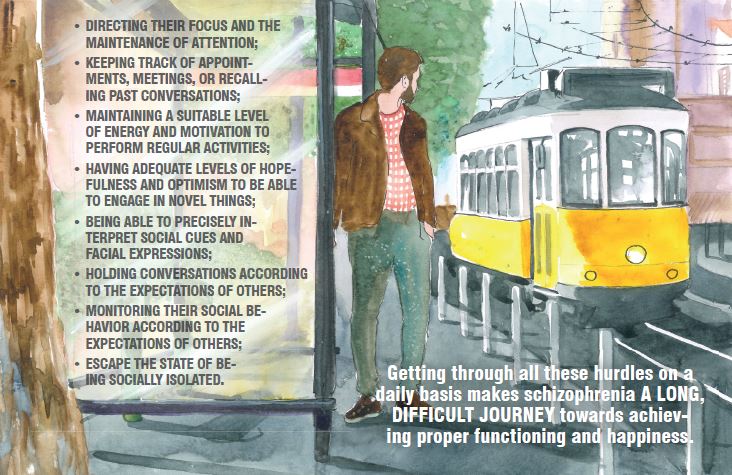
Social functioning
One of the distinguishing aspects of schizophrenia is SOCIAL DYSFUNCTION, and many people living with the disorder find it difficult to interact with others, even when their psychotic symptoms are under control. As a result, for people with schizophrenia, the illness can become a constant struggle to figure out HOW TO FIT INTO SOCIETY.
In this regard, the most debilitating symptoms are PARANOIA AND DELUSIONS. The belief that others are trying to hurt them or are thinking bad things about them makes it very difficult for people with schizophrenia to have a dialogue or keep their calm in any kind of social situation.
One of our most important social interactions is, of course, establishing a romantic relationship with another person. Generally, people aspire to form romantic relationships
and start a family. However, a serious, long-term illness, like schizophrenia brings along a SERIES OF PARTICULAR DRAWBACKS, which makes it troublesome to form and maintain close relationships.
The most significant of these drawbacks is THE NEED TO ADAPT TO THE ILLNESS, which may cause alienation in the relationship due to the presence of stigmatization and self stigmatization. The stigma of schizophrenia leads to a vicious CYCLE OF SELF-STIGMATIZATION AND ISOLATION, decreasing social functioning, which in turn amplifies the stigma. Self-stigmatization also leads to low self-esteem. As a result, the large majority of people with schizophrenia have the belief that others do not have the desire of being with a partner diagnosed with such illness. Hence, schizophrenia results in a reduced prospect of getting married, particularly for men, and an increased risk for broken marriages regarding women. Love relationships are also COMPLICATED BY INTERNAL OBSTACLES, described by people with schizophrenia as losing a part of themselves, modifications to the experience of emotions, and challenges with accepting alternative beliefs.
They also report diminished trust towards others but also themselves, as well as towards their own memories, feelings, perceptions, and desires.
There are also more practical challenges. Schizophrenia (and certain antipsychotic medications) may cause people to become less interested in sex. Some antipsychotics can cause weight gain, while the person taking them may FEEL UNATTRACTIVE. For people who have had schizophrenia for many years, poverty can also become a roadblock in creating and sustaining relationships.
All these difficulties might lead to the belief that love and schizophrenia are not compatible. However, regardless of the chaos in their minds and the lingering impact of psychotic experiences, most people with schizophrenia have the ability to communicate nuanced feelings and outlooks towards love.
THEY NEED TO LOVE AND TO BE LOVED.
They have a strong desire for meaningful relationships, romance, and family. It’s just that the illness does not allow their self to express the full extent of its potential. Although it means a lot of work, if the disease of your loved one is kept under control, establishing a romantic relationship with someone who accepts them as they are can have a huge positive impact on their life.
Occupational functioning
People with schizophrenia are known to have a LOWER PERFORMANCE IN WORK-RELATED TASKS as a result of their altered cognitive functioning and negative symptoms
When the illness is not adequately controlled by medication, it can severely affect both
their PHYSICAL AND MENTAL WORK CAPACITY. Hallucinations can make physical
work impractical and can be dangerous for your loved one but also for others in the
workplace. Most people with schizophrenia will also struggle with DISORGANIZED THINKING, SPEECH, AND BEHAVIOUR, symptoms that make it very difficult to function in a work environment.
The first symptoms of schizophrenia usually appear around the age when individuals are attending college. This period in their life can be marked by a psychotic episode, and it is natural for this event to be considered the end of what was supposed to be a successful life. But the reality is different and if symptoms are successfully controlled, enrolling back into education or getting a job may be UTTERLY POSSIBLE.
It is in our nature as humans to have a better feeling about ourselves when we are engaged
in useful tasks. Your loved one is also able to pursue their life goals, a journey that has a
significant impact on their recovery. WORKING IMPROVES THEIR SELF-CONFIDENCE AND GIVES THEM A SENSE OF BELONGING, INCREASING AT THE SAME TIME THE QUALITY OF THEIR LIFE.
When looking for a job, one of the major impediments in the case of people with schizophrenia is not having a clear idea of where to begin. Many of them possess minimal to
no work experience at all and are not able to make out the nature of work they would be capable of pursuing. Therefore, it is very important to make sense of what they excel at by observing their PERSONAL QUALITIES and also to have a good understanding of the current job market prior to the job hunt. However, most individuals with schizophrenia have the willingness and ability to flourish in their workplace if they find a job that matches their interests, acknowledges their strengths and skills, and is accommodating to them.
LIVING WITH SCHIZOPHRENIA DOES NOT IMPLY THE IMPOSSIBILITY OF HAVING
A CAREER OR SUCCESSFUL LIFE. As long as there is a positive treatment response, it
is highly probable that people can accomplish whatever it is that they aspire to.
Assist with therapy and progress tracking
A person with schizophrenia will almost certainly be recommended prescription medication.
As a caregiver, you may find yourself involved in tasks that include:
• picking up prescriptions;
• keeping a record of the use of medication;
• paying attention to side effects and reporting these to the doctor or psychiatrist;
• encouraging your loved one to take their medication at regular intervals;
• using a preplanned schedule to keep track of the medication use;
• encouraging the use of a pillbox or timer;
• assisting with long-acting injection type medication;
• consulting with the doctor regarding possible drug interactions;
• keeping a register of which medications and supplements are being taken;
• taking care that other substances, such as drugs or alcohol are not combined with the medication;
• keeping notes of medication to assess which one is personally more effective;
• keeping track of why some of the medications were changed.
TAKE SIDE EFFECTS SERIOUSLY. After noticing side effects, a vast number of individuals with schizophrenia quit taking their medication. A better alternative would be to bring up the undesired side effects to the doctor’s attention, who can either reduce the dose, prescribe a different antipsychotic, or add another medication to combat specific side effects.
ENCOURAGE YOUR LOVED ONE TO TAKE MEDICATION REGULARLY.
Even if the side effects are controlled, individuals with schizophrenia may reject their medication or simply find it difficult to remember when and how much of it to take. In such cases, they might find it helpful to install medication reminder apps, make use of weekly pillboxes and keep calendars on hand.
BE CAREFUL TO AVOID DRUG INTERACTIONS.
In order to prevent your loved one from any drug interactions, present the doctor supplements that they take. Combining schizophrenia medication with either alcohol or illegal drugs can cause serious harm.
In case the person you take care of has a problem with abusing substances, it is important to inform the doctor about it.
TRACK YOUR FAMILY MEMBER’S PROGRESS. A good way to monitor the changes in behaviour and other symptoms your family member experiences as a result of taking medication are mood tracking apps, journal entries, and keeping a diary.
Your loved one may also attend cognitive behavioral therapy or social skills training. Your
responsibility as the caregiver could be assisting them with their commute to therapy, ensuring they keep their therapy ongoing, or helping them with homework tasks. When KEEPING TRACK of your loved one’s adherence to treatment and their overall progress, it is easy to become overprotective.
Make sure you RESPECT their privacy and personal boundaries. By giving them responsibilities (e.g., to take their medicine every day at the specified time), you are empowering and motivating them, providing a sense of purpose in their life.

Staying on track with medication
Ensuring that an ill person takes their medication regularly and consistently is called “COMPLIANCE” or “ADHERENCE”.*
Although it doesn’t seem too difficult, compliance is actually one of the most challenging factors for long-term treatment in any type of illness.
In schizophrenia, the problem of non-compliance is significant: only 58% of patients collect their medication in the first 30 DAYS after hospital discharge, and only 46% continue their initial treatment for 30 DAYS or longer. This high rate of non-compliance can be explained by poor insight into the illness, cognitive problems, side effects, and substance abuse associated with schizophrenia. Stressful events that turn their lives upside down for long periods of time, such as the recent COVID pandemic and the restrictions that came with it, can also make it more difficult for them to take their medicine consistently or attend therapy appointments. Also, many people with schizophrenia do not recognize they are ill; hence they don’t understand why they need medication. Figuring out the appropriate dose or combination is usually TIME-CONSUMING, and it’s a difficult process that can lead persons with schizophrenia